⚡ Quick Answer: Before starting IVF in Patna, ask your doctor about their live birth rates (not just “success rates”), IVF-specific qualifications, whether they personally perform your procedures, lab quality, personalised protocols, complete itemised costs, and experience with your specific fertility condition. Dr. Rashmi Prasad of Diwya Vatsalya Mamta Fertility Centre has answered these below.
Choosing an IVF doctor is one of the most important decisions on your parenthood journey. Unlike picking a general physician, your fertility specialist directly shapes every stage — diagnosis, ovarian stimulation, embryo development, embryo transfer, and ultimately your chances of holding your baby.
Patna has grown into a major fertility treatment hub in Bihar over the last decade. More clinics means more choice, but also more confusion — every clinic promises high success rates and modern technology, yet expertise, transparency, and individual care vary widely between them.
A wrong choice can be emotionally and financially costly. A failed IVF cycle isn’t just “another procedure” — it often means more months of waiting, more expense, and renewed emotional strain for couples who have already been through a lot.
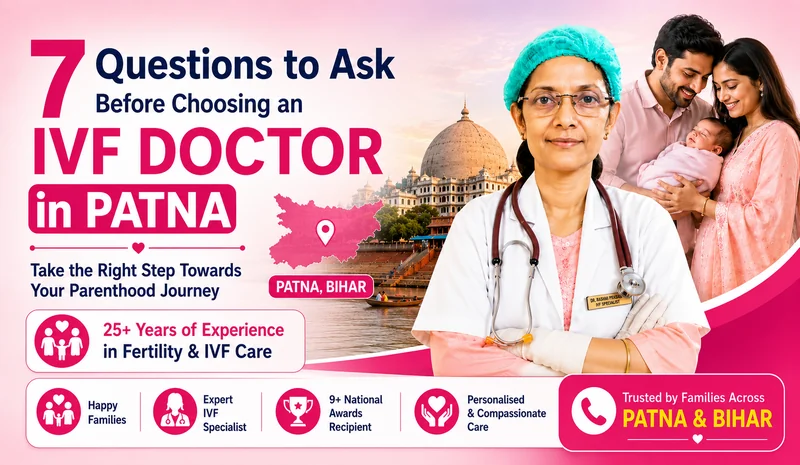
This guide lays out seven practical questions every couple should ask before choosing an IVF Specialist Doctor in Patna. These aren’t marketing checkboxes — they help you understand a doctor’s qualifications, treatment philosophy, lab standards, and commitment to patient care. Each answer below reflects the approach of Dr. Rashmi Prasad, Founder and Director of Diwya Vatsalya Mamta Fertility Centre, who brings more than 25 years of experience in reproductive medicine.
Why Choosing the Right IVF Doctor in Patna Matters
IVF is far more layered than most people assume. A successful outcome relies on a chain of well-coordinated medical decisions: fertility evaluation, hormonal stimulation, follicle monitoring, egg retrieval, fertilisation in the lab, embryo culture and selection, embryo transfer, and pregnancy monitoring. A small miscalculation in drug dosage, embryo grading, or transfer timing at any of these stages can change the outcome.
- Success rates vary significantly between clinics — doctor’s clinical experience, laboratory quality, embryologist expertise, and individual protocols all influence outcomes, even for similar diagnoses.
- A failed cycle doesn’t mean IVF can’t work for you — a trained specialist reviews what went wrong (protocol, egg quality, transfer timing, overlooked issues) rather than repeating the same plan.
- Lab quality matters as much as medical expertise — embryos develop over 3–5 days under tightly controlled temperature, air quality, and culture conditions.
- Most families in Bihar have limited time and budget for repeated cycles — which makes asking the right questions upfront a necessity, not a luxury.
You can also read a real IVF success story from Patna to see how these factors play out in practice.
Question 1: What Are Your IVF Success Rates, and How Do You Calculate Them?
Simply asking “What’s your success rate?” isn’t enough — the number can mean very different things depending on how it’s measured.
Why the Wording Behind “Success Rate” Matters
Clinics may report positive pregnancy test rates, chemical pregnancy rates, clinical pregnancy rates, implantation rates, or live birth rates. Live birth rate is the most meaningful measure, since it reflects the actual outcome couples are hoping for — a healthy baby.
Question 2: What Are Your Qualifications and IVF-Specific Training?
Not every gynaecologist is trained in fertility treatment. IVF draws on reproductive endocrinology, embryology, hormonal management, assisted reproductive technology, and laboratory medicine — skills that go beyond general obstetrics and gynaecology.
- MBBS – Shri Krishna Medical College, Muzaffarpur (1993)
- DGO – PMCH, Patna (1997)
- DNB in Obstetrics & Gynaecology – PMCH, Patna (2000)
- MBBS, DGO, DNB, PG-ART (University of Kiel, Germany)
Question 3: Who Will Actually Perform My IVF Procedure?
Many couples assume the senior doctor they meet at consultation will personally handle every stage of treatment — but at some multi-doctor fertility chains, one doctor consults, another performs egg retrieval, and a third handles the embryo transfer, with follow-ups spread across rotating consultants.
Question 4: What Is the Quality of Your IVF Laboratory?
The IVF lab is often called the core of a fertility centre — embryos develop there over 3–5 days, and even small changes in temperature, humidity, air quality, or culture conditions can affect their development.
Question 5: Do You Personalise IVF Protocols, or Use the Same Plan for Everyone?
No two infertility cases are alike. A woman with PCOS in her twenties needs a very different protocol than a woman with low AMH in her late thirties, and couples facing severe male infertility, recurrent miscarriage, or repeated IVF failure need individual planning, not a standard formula.
Question 6: What Is the Complete Cost of IVF? Are There Hidden Charges?
IVF is one of the biggest medical expenses many families will face. Some clinics quote an attractive starting price that later grows with add-on fees for medications, lab tests, embryo freezing, anaesthesia, or extra procedures — leaving the final bill far higher than expected.
Question 7: Have You Treated Patients With My Specific Fertility Condition?
Infertility isn’t one condition. PCOS, low ovarian reserve, recurrent miscarriage, male infertility, and repeated IVF failure each call for a different clinical approach — and a doctor experienced with your specific diagnosis is more likely to anticipate challenges early.
Your IVF Doctor Checklist
Bring this checklist to every consultation. A qualified fertility specialist will answer these clearly:
- What is your live birth rate for patients in my age group and diagnosis?
- What are your qualifications and specialised training in reproductive medicine?
- Will you personally perform my egg retrieval and embryo transfer?
- What facilities and quality standards does your IVF lab maintain?
- How will my protocol differ from a standard IVF cycle?
- Can you give a complete, itemised cost estimate before treatment begins?
- How much experience do you have with my specific fertility condition?
Travelling to Patna for IVF? What to Know
Diwya Vatsalya Mamta Fertility Centre welcomes patients from across Bihar and neighbouring states, including Muzaffarpur, Darbhanga, Gaya, Bhagalpur, Samastipur, Begusarai, Purnia, Motihari, Sitamarhi, Ranchi, other parts of Jharkhand, and eastern Uttar Pradesh.
- Initial consultation: previous reports are reviewed in detail so a treatment plan can often be prepared in a single visit.
- Treatment schedule: the active stimulation and monitoring phase generally needs patients to stay near the clinic for about 10–12 days; accommodation near Patliputra Colony is convenient.
- Remote monitoring: select stages can be coordinated with trusted ultrasound centres in your hometown to reduce travel before the active cycle begins.
- Language: consultations are available in Hindi, Bhojpuri, and English.
📍 Clinic Details
Address: House No. 234–235, Road No. 1, Near Laddu Gopal Sweets, Patliputra Colony, Patna, Bihar – 800013
OPD Hours: Monday to Saturday, 9:00 AM – 6:00 PM
Phone / WhatsApp: +91-8051761659
Email: info@drrashmiprasad.com
Frequently Asked Questions
What should I look for when choosing an IVF doctor in Patna?
Look beyond cost or success-rate claims. Choose a doctor with specific reproductive medicine experience, a modern IVF lab, personalised protocols, transparent pricing, and a track record with cases similar to yours — someone who communicates openly and stays involved throughout your treatment.
What questions should I ask an IVF doctor before starting treatment?
Ask about live birth rates for your age and diagnosis, qualifications and IVF-specific training, whether they personally perform your procedures, lab quality standards, whether protocols are personalised, a complete itemised cost estimate, and their experience with your specific condition.
What is the difference between a good IVF clinic and a poor one?
A good clinic has skilled fertility experts, certified embryologists, a well-equipped lab, individualised treatment planning, ethical care, and clear pricing. A poorly run clinic may promote unrealistic success rates, rotate consultants, use outdated equipment, or prescribe IVF without a proper evaluation. Choosing a clinic that’s experienced and transparent significantly improves your confidence throughout treatment.
Is IVF success in Patna comparable to Delhi or Mumbai?
Yes. IVF outcomes depend mainly on the specialist’s skill, lab quality, embryo culture standards, and individual treatment planning — not the city. Well-trained specialists in Patna use the same globally recognised procedures and lab standards as bigger-city clinics.
How can I verify whether an IVF clinic in Patna is trustworthy?
Check that the clinic operates under applicable ART/ICMR regulations, has qualified fertility specialists with verifiable credentials, a dedicated IVF lab, and transparent itemised pricing. Reading patient reviews and asking direct questions about the lab and procedures also helps — a trustworthy clinic welcomes these questions rather than avoiding them.
Can I undergo IVF in Patna instead of travelling to Delhi or Mumbai?
Yes. Patna has become a genuine hub for advanced reproductive medicine, with experienced specialists like Dr. Rashmi Prasad offering internationally trained care close to home — sparing patients the extra cost, travel, and strain of visiting a metro city.
What is the average cost of IVF in Patna?
IVF in Patna typically costs between ₹1.2 lakh and ₹2 lakh per cycle, depending on medications, stimulation protocol, ICSI, embryo freezing, and any additional procedures your case needs. Always ask for a written, itemised estimate before starting treatment.
Does an IVF doctor’s experience really affect treatment success?
Yes. Experience helps a doctor handle unexpected challenges — poor response to stimulation, fertilisation issues, embryo quality concerns, implantation failure, or repeated miscarriage — and adjust the protocol accordingly. Dr. Rashmi Prasad’s 25+ years in reproductive medicine inform how she tailors care to each patient.
Should I choose a female IVF specialist in Patna?
Many women feel more comfortable discussing sensitive fertility concerns with a woman specialist. Dr. Rashmi Prasad, a senior female IVF specialist in Patna, consults in Hindi, Bhojpuri, and English, helping women across Bihar discuss their concerns openly.
Where is Diwya Vatsalya Mamta Fertility Centre located, and how do I book a consultation?
The clinic is at House No. 234–235, Road No. 1, Near Laddu Gopal Sweets, Patliputra Colony, Patna, Bihar – 800013, open Monday to Saturday, 9 AM–6 PM. Book a free first consultation by calling or WhatsApping +91-8051761659, or emailing info@drrashmiprasad.com.
Begin Your Parenthood Journey with Confidence
Choosing an IVF specialist isn’t about advertisements or package prices — it’s about finding a doctor with credentials, experience, transparency, and genuine compassion to guide you through one of life’s most significant journeys. With over 25 years of experience, international training, personalised treatment planning, and ethical patient care, Dr. Rashmi Prasad helps couples make informed decisions from the very first consultation.
Ready to take the next step toward parenthood?
📞 Call / WhatsApp +91-8051761659 | ✉️ info@drrashmiprasad.com